§1Introduction
This study began with a production incident in an agentic alerting pipeline. A threshold engine evaluated the operator’s configured rule for a real solar and geomagnetic alert and fired correctly, but its output omitted the operative threshold. The downstream agent reasoned from a stale threshold label and de-escalated the warning. A production judge assigned the output a failing score and returned no rationale; our first explanation of that score was wrong. In the corrected reconstruction, the evaluator behaved like a near-binary conjunctive floor: any single defect saturated the score, and only a fully correct output rose above it.
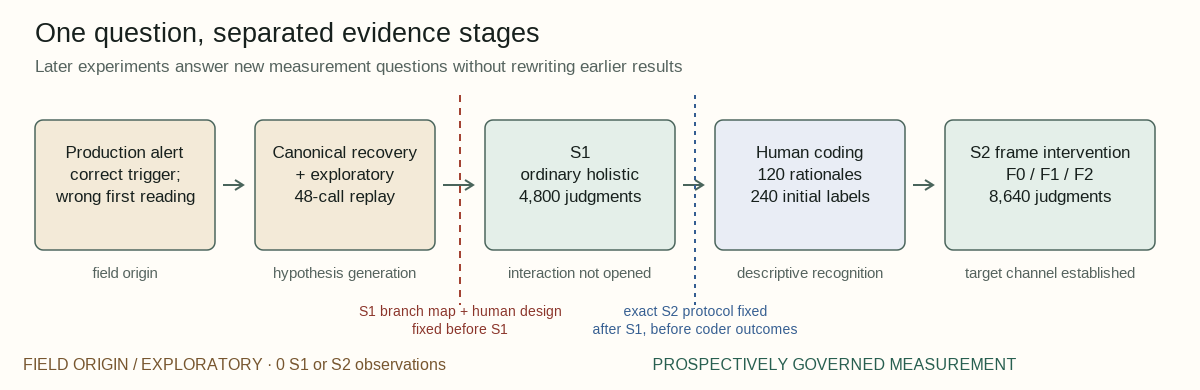
The reconstruction also exposed a procedural error: a rubric-hash mismatch caught a trailing newline in an early arm, and that conclusion was withdrawn. With canonical inputs restored, a temperature-zero 2 × 2 replay crossed routing quality with acknowledgment versus denial framing over 32 calls; a separately governed neutral control added 16. Routing changed scores under acknowledgment but not denial or neutral framing. This contemporaneously specified 48-call sequence was not formally preregistered and its observed branch was not anticipated. It is field-origin evidence, not a confirmatory sample.
The practical problem is not simply whether an LLM judge is accurate. It is whether a scalar channel carries information about the construct on which an engineering decision depends. If an evaluator distinguishes a defect alone but not when another defect is present, per-dimension validation can miss a compound failure. Conversely, if the criterion never made the target defect measurable, a downstream interaction is not identified even when its point estimate appears suggestive.
Prior work documents position and self-preference biases (Zheng et al., 2023; Shi et al., 2025; Wataoka et al., 2024), together with large rater-severity and version effects, a distinction between self-consistency and validity, and calibration-sensitive halo findings (Sunkavalli, 2026). G-Eval and Prometheus structure evaluation through explicit criteria or fine-grained rubrics (Liu et al., 2023; Kim et al., 2024). More closely, fixed-judge instruction framing can shift benchmark rates (Zhang, 2026); requiring a judge to commit an answer before seeing a candidate can restore correctness discrimination (Zhou, 2026); matched adversarial pairs can expose failures to track an instruction-bearing contrast (Zeng et al., 2024); and rubric-only probes and criterion-reversal tests can expose label-correlated rubric signals and counterfactual nonresponsiveness (Bagaria et al., 2026). Those studies test agreement, bias, stability, prompt sensitivity, or evaluator design. We hold artifact truth and evaluator configuration fixed while changing whether the same target is absent, named, or score-bound: does the score discriminate the construct needed by the downstream claim?
The evidence developed in four stages as a sequentially prospective program, not under one master preregistration (Figure 1). Before S1, a sealed branch map routed failure to establish standalone target discrimination to criterion ablation, and the human-coding design was fixed. After S1 selected that branch, but before any human-coder outcome, the exact S2 frames, estimands, thresholds, and decision rules were fixed. Later successors operationalized the same scientific design and were finalized before S2 collection.
§2Methods
2.1Evidentiary separation and S1
The production event and replay contributed no S1 or S2 observation. The deposit preserves their recovered inputs, mismatch, branch, control, and temporal proofs. Ten frozen specimens entered S1. Three semantic-open and three mixed specimens formed the primary corpus; four prospectively selected mechanical-bounded specimens formed a separate, never-pooled control vector. A deterministic repository-screening workflow (repoABRunner) supported discovery; no model generated or edited inputs.
Across specimens, A and B denoted experimental roles rather than common defect categories. Fixed, specimen-specific construction rules rendered four states: neither defect (00), only co-occurring defect A (A0), only target defect B (0B), and both (AB). For example, in one editorial-review specimen, A was broken punctuation (“Targets the receptor,.”) while B was the reviewer’s failure to flag an unsupported promotional slogan (“Best of all”).
The three judges were fixed provider/model/route/settings bundles: L1, Anthropic Claude Sonnet 5; L2, OpenAI GPT-6 Sol; and L3, xAI Grok 4.7. Each used the same holistic criterion and score/rationale/refusal schema, without repository access, retrieval, tools, conversation memory, or cross-item state. Because bundle components were not independently crossed, differences belong to these setups and are not provider effects.
Each specimen×cell×judge stratum was filled to 40 canonical observations under fixed schema, completion, route, provenance, cache, and token rules. Collection made 4,803 attempts to retain 4,800 observations: two schema-invalid responses and one timeout were replaced. Schema-valid refusals remained observations; content and score were never replacement criteria.
For independent ordered scores X and Y, tie-adjusted probability of superiority was the Vargha–Delaney A measure (Vargha and Delaney, 2000):
For each semantic specimen and judge, standalone B discrimination was P0 = PS(00, 0B), discrimination with A present was PA = PS(A0, AB), and conditional attenuation was I = P0 − PA. Specimens received equal weight. Meaningful standalone discrimination required 0.70; meaningful attenuation required 0.15. An ESTABLISHED standalone claim required its simultaneous interval wholly at or above 0.70, positive effects in at least four of six specimens, and positive leave-one-specimen-out means, after provenance and validity gates cleared. Only a judge clearing that prerequisite and the six-specimen ordinal range-capacity gate could open attenuation. INDETERMINATE means the registered region was unresolved, not absent. Simultaneous inference controlled familywise error across the three judge-specific claims. Before outcomes, 30,000 end-to-end known-truth replications passed all 153 qualification checks.
2.2Human recognition coding
A response-free schedule selected 120 S1 rationales, balanced across the six semantic specimens and three judges: 40 each from target-present 0B and AB, and 20 each from 00 and A0. Coders saw only the specimen-specific issue statement and verbatim rationale, not score, cell, judge identity, hypothesis direction, or another answer.
Three coders used a rotating-pair design with labels RECOGNIZED, NOT_RECOGNIZED, and UNCERTAIN. The omitted coder adjudicated disagreements blind to initial labels. Agreement or a two-of-three majority became final; all-different triples became UNCERTAIN. Reliability used Krippendorff’s alpha (Krippendorff, 2004) and pairwise Cohen kappas (Cohen, 1960). The task measured explicit written recognition, not latent cognition.
The nonrepresentative coders were salaried employees of businesses managed or co-owned by the study lead. They volunteered outside paid duties, received no separate compensation, knew the workload, and could decline.
2.3S2 frame intervention
S2 reused the exact six semantic specimens, four cells, three judges, and N = 40 while crossing three frames:
- F0 ordinary holistic: the exact S1 criterion, with no target-issue description;
- F1 named holistic: the exact target-issue description was supplied and had to be considered, but one overall score remained; and
- F2 target bound: the byte-identical description was supplied and the score was bound solely to resolution of that issue.
F1 − F0 represents naming/information and F2 − F1 incremental score binding. For the A-absent contrast, G0 = P0(F2) − P0(F1). S2 comprised 2,880 primaryless multiplex groups and 8,640 canonical evaluations across 40 seeded waves.
Within each frame, S2 retained P0, PA, and I. For each judge, complete binding recovery was an intersection-union claim: every registered component had to clear. Components included an F2 standalone interval wholly at or above 0.70, an F2–F1 gain interval wholly at or above 0.15, positive gain in at least four of six specimens, and positive leave-one-out gain. Holm adjustment controlled the probability of falsely declaring at least one of three judge-specific primary claims at 0.10 (Holm, 1979). Each component used the preregistered finite e-value procedure. Evidence was averaged across the 40 waves, and the merged e-value was converted to a bounded p-value following Vovk and Wang (2021); simultaneous intervals were obtained by inversion of the corresponding tests.
A prospectively fixed interpretation router accepted only registered dispositions and gain classifications, not favorable point estimates. F2 standalone success was explicitly registered as a manipulation check expected by construction.
2.4Provenance and analysis separation
Calls passed through separate dedicated local Holonograph Lens instances (v0.43.6; holonograph.ai), which supplied call-time correlation, route and served-model identity, usage and cache fields, substrate stamps, cohort tags, and immutable digest-only events. Raw requests and responses remained outside Lens events. Holonograph is developed by the author.
FRAME controllers owned schedules, payloads, private responses, validation, retries, resume state, and analysis inputs. Separately versioned, digest-bound engines ran under single-use authorizations; private results were bound before aggregate interpretation. Analysis implementations were challenged with synthetic known-truth cases and broken controls. Blacklight is the later public, study-free extraction of that pattern; it did not qualify either study. Public commitments and aggregate records are indexed at github.com/inspectorSlap/attestations, deposit llm-judge-evaluation-frames-v0.1, root SHA-256 a962a2d910f3f62b4002a4b327bf3ef7f368b828dd6e8801e048b2d0840b4b6b. Private records are excluded.
§3Results
3.1S1 did not open attenuation
All 4,800 scheduled observations closed. Range and validity gates were supported, but standalone B discrimination was INDETERMINATE for every judge (Table 1). L2’s point estimate exceeded 0.70, but its familywise disposition did not clear the registered region. L1’s negative interaction estimate is descriptively unusual, but its interval crossed zero and attenuation was never eligible. S1 therefore neither replicated nor refuted the incident-local pattern: the ordinary holistic score was not shown to carry enough B-specific information to support the downstream claim.
| Judge | P0 point estimate [simultaneous 90% interval] | I point estimate [simultaneous 90% interval] | Familywise disposition |
|---|---|---|---|
| L1 | 0.567 [0.479, 0.636] | −0.145 [−0.281, 0.027] | Standalone indeterminate; attenuation ineligible |
| L2 | 0.722 [0.610, 0.791] | 0.072 [−0.094, 0.223] | Standalone indeterminate; attenuation ineligible |
| L3 | 0.562 [0.471, 0.636] | −0.025 [−0.179, 0.136] | Standalone indeterminate; attenuation ineligible |
Table 1. S1 point estimates, simultaneous 90% reporting intervals, and preregistered familywise dispositions. Family decisions also incorporate recurrence, leave-one-out, range, validity, structural, and Holm-adjustment rules.
Post-result exploratory analysis found that 86.3% of scores fell at 2, 3, or 4. Holonograph’s marginal transfer-curve diagnostic did not flag the full surface, whereas 7 of 38 declared conditional slices were concentrated or quantized. This does not establish a plateau or cliff; controlled perturbation remains necessary.
3.2Written recognition was not reliably coded
Initial pairs agreed on 34/120 items (28.3%) and disagreed on 86/120 (71.7%). Nominal Krippendorff alpha was −0.143; pairwise kappas ranged from −0.144 to −0.038. Negative alpha means agreement fell below the statistic’s chance expectation given label marginals: poor instrument reliability, not inverse truth or model non-recognition. Forty-three adjudications produced all three labels and resolved to UNCERTAIN.
Final labels were 57 recognized (47.5%), 17 not recognized (14.2%), and 46 uncertain (38.3%). B-present recognition was 19/40 (47.5%) in 0B and 25/40 (62.5%) in AB, giving descriptive R0 − RA = −0.15. B-absent recognition was 5/20 (25%) in 00 and 8/20 (40%) in A0. These values neither establish model recognition nor rescue the ordinal result.
3.3S2 established the target-bound channel, not binding recovery
S2 completed all 2,880 groups and 8,640 canonical evaluations without replacement. Figure 2 reports the frame-level results; exact values appear in Appendix Table A1. F2 was ESTABLISHED for all judges. F1 was ESTABLISHED for L2 and L3 and INDETERMINATE for L1. L1’s F1 lower bound was 0.698, about 0.002 below the registered 0.70 boundary; its status reflects uncertainty at the boundary rather than descriptively weak discrimination.
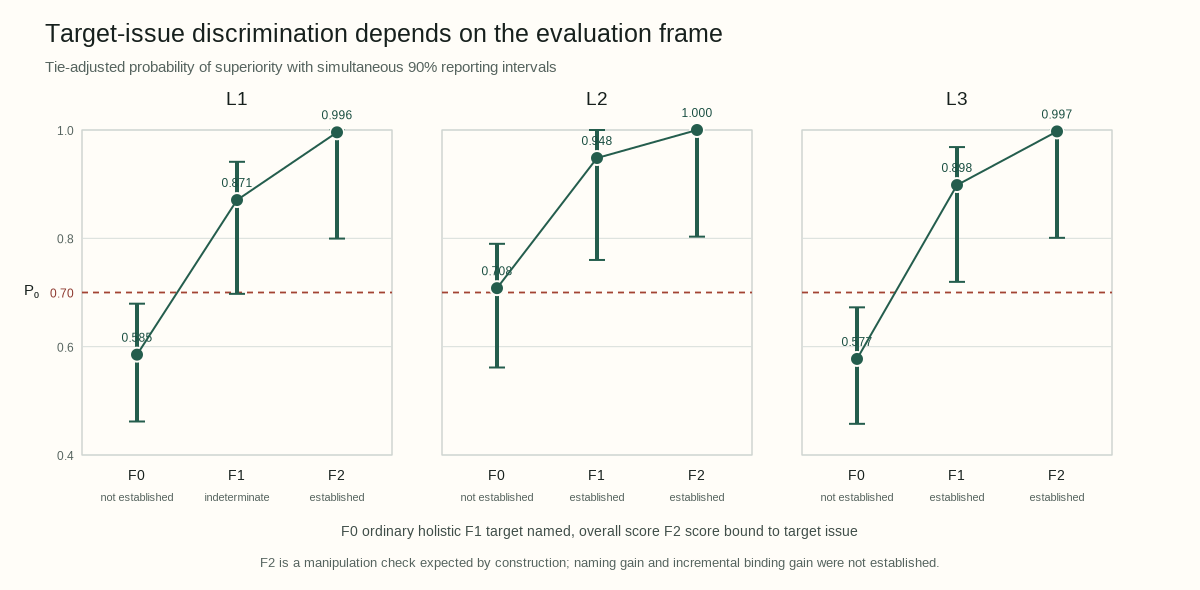
Complete binding recovery was NOT_SUPPORTED for all three judges. Incremental binding-gain estimates were 0.125, 0.052, and 0.099, below 0.15. At the registered G0 ≥ 0.15 boundary, the average e-value did not exceed 1 for any judge; because the intersection-union procedure takes the largest component p-value, every exact raw and Holm-adjusted primary p-value was 1.0. The inverted unconditional two-sided interval can extend above 0.15 without establishing the registered one-sided gain.
At the observed F1 estimates, the bounded superiority scale left at most 0.129, 0.052, and 0.102 of possible point-estimate gain; no possible F2 estimate could clear 0.15. This does not alter the dispositions or rule out an underlying effect because F1 is uncertain; the result is not evidence that binding added little.
Neither naming nor incremental binding gain was established. Frame-level attenuation was ineligible or stopped by the registered range-capacity gate, so the fixed router returned an indeterminate attenuation pattern for every judge. Descriptively, all followed F0 < F1 < F2, with the larger increment from F0 to F1, but neither gain cleared the simultaneous procedure.
§4Discussion
An LLM judge does not measure an artifact in isolation. Its score measures the artifact as rendered through a criterion and frame. Under S1’s ordinary holistic frame, the target contrast was not established strongly enough to support attenuation. Under S2’s target-bound frame, the same contrast was highly discriminable for all three judges.
F2 success does not imply full recovery. It was an expected manipulation check; the complete claim also required meaningful gain over F1, recurrence, leave-one-out robustness, and the family procedure. Those conditions were not established. A target-bound channel can be constructed, but binding does not thereby explain S1 or identify attenuation.
F1 may be most informative descriptively. Naming the target produced the largest point-estimate increase in all three judges; L2 and L3 established the named channel, and L1 nearly cleared the lower-bound threshold. Yet formal naming gain remained indeterminate. This pattern can motivate another experiment without becoming an unsupported claim.
The human substudy adds a warning: coders disagreed on more than seven of every ten items, with negative chance-corrected agreement, and sometimes labeled B-absent rationales recognized. Free-text recognition is itself a measurement problem.
For AI engineering, before trusting a judge for release gates, regression tests, or model comparison, establish that its frame discriminates each needed construct. Compound-defect tests ask whether discrimination survives co-occurrence; frame ablations locate whether target information is absent, named, or score-bound. A global agreement statistic replaces neither.
Provenance made this refusal interpretable: hashes, approvals, and timestamps preserved each stage’s inputs, responses, and decisions. They did not make the hypothesis true or validate its interpretation.
Limitations remain. The corpus and bundled judge setups are fixed targets, not population samples; F2 intentionally eases discrimination and is first a manipulation check. Human labels concern explicit text and three nonrepresentative coders employed by the study lead’s businesses. The replay is exploratory. Because the scale is bounded, the 0.15 gain was unattainable conditional on observed F1 point estimates; successors should scale thresholds to remaining headroom. S1’s 2/3/4 concentration is not a causal transfer curve and requires perturbation.
§5Conclusion
Before testing an interaction, establish that its frame makes the construct measurable. Withholding an unsupported claim is not a failure to produce a result; it is what a trustworthy evaluation system should do when the measurement channel and scientific claim differ.
AComplete S2 Frame Estimates
| Judge | F0 P0 [90% interval] | F1 P0 [90% interval] | F2 P0 [90% interval] | G0 [90% interval] | Complete recovery |
|---|---|---|---|---|---|
| L1 | 0.585 [0.462, 0.679] | 0.871 [0.698, 0.941] | 0.996 [0.800, 1.000] | 0.125 [−0.102, 0.305] | Not supported |
| L2 | 0.708 [0.562, 0.790] | 0.948 [0.760, 1.000] | 1.000 [0.803, 1.000] | 0.052 [−0.161, 0.246] | Not supported |
| L3 | 0.577 [0.458, 0.673] | 0.898 [0.720, 0.968] | 0.997 [0.801, 1.000] | 0.099 [−0.122, 0.284] | Not supported |
Table A1. S2 discrimination and incremental binding-gain estimates with simultaneous 90% intervals. G0 = F2 − F1.
Ethics Statement
This privately conducted, non-clinical study collected no sensitive personal or patient data. Three knowledgeable coders volunteered outside ordinary paid duties, received no separate compensation, knew the approximate workload, and could decline. They were salaried employees of businesses managed or co-owned by the study lead; this convenience relationship and the coders’ nonrepresentativeness limit generalization. Only aggregate descriptive labels are reported. Private coder returns, row-level labels, rationales, and crosswalks remain nonpublic.
References
- Anshul Bagaria, Sowmya S. Sundaram, Gokul S. Krishnan, and Balaraman Ravindran. 2026. Judging LLM-as-a-judge: Concerning rubric artifacts in LLM-based automated text generation evaluation. arXiv preprint arXiv:2609.02942. doi.org/10.48550/arXiv.2609.02942
- Jacob Cohen. 1960. A coefficient of agreement for nominal scales. Educational and Psychological Measurement, 20(1):37–46. doi.org/10.1177/001316446002000104
- Sture Holm. 1979. A simple sequentially rejective multiple test procedure. Scandinavian Journal of Statistics, 6(2):65–70. jstor.org/stable/4615733
- Seungone Kim, Jamin Shin, Yejin Cho, Joel Jang, Shayne Longpre, Hwaran Lee, et al. 2024. Prometheus: Inducing fine-grained evaluation capability in language models. In The Twelfth International Conference on Learning Representations. openreview.net/forum?id=8euJaTveKw
- Klaus Krippendorff. 2004. Reliability in content analysis: Some common misconceptions and recommendations. Human Communication Research, 30(3):411–433. doi.org/10.1111/j.1468-2958.2004.tb00738.x
- Yang Liu, Dan Iter, Yichong Xu, Shuohang Wang, Ruochen Xu, and Chenguang Zhu. 2023. G-Eval: NLG evaluation using GPT-4 with better human alignment. In Proceedings of the 2023 Conference on Empirical Methods in Natural Language Processing, pages 2511–2522. doi.org/10.18653/v1/2023.emnlp-main.153
- Lin Shi, Chiyu Ma, Wenhua Liang, Xingjian Diao, Weicheng Ma, and Soroush Vosoughi. 2025. Judging the judges: A systematic study of position bias in LLM-as-a-judge. In Proceedings of the 14th International Joint Conference on Natural Language Processing and the 4th Conference of the Asia-Pacific Chapter of the Association for Computational Linguistics, pages 292–314. doi.org/10.18653/v1/2025.ijcnlp-long.18
- Veerendra Kumar Sunkavalli. 2026. LLM judges as raters: A pre-registered audit of severity, halo, reliability, and version instability in LLM essay scoring on public corpora. arXiv preprint arXiv:2608.29517. doi.org/10.48550/arXiv.2608.29517
- András Vargha and Harold D. Delaney. 2000. A critique and improvement of the CL common language effect size statistics of McGraw and Wong. Journal of Educational and Behavioral Statistics, 25(2):101–132. doi.org/10.3102/10769986025002101
- Vladimir Vovk and Ruodu Wang. 2021. E-values: Calibration, combination, and applications. The Annals of Statistics, 49(3):1736–1754. doi.org/10.1214/20-AOS2020
- Koki Wataoka, Tsubasa Takahashi, and Ryokan Ri. 2024. Self-preference bias in LLM-as-a-judge. arXiv preprint arXiv:2410.21819. doi.org/10.48550/arXiv.2410.21819
- Zhiyuan Zeng, Jiatong Yu, Tianyu Gao, Yu Meng, Tanya Goyal, and Danqi Chen. 2024. Evaluating large language models at evaluating instruction following. In The Twelfth International Conference on Learning Representations. openreview.net/forum?id=tr0KidwPLc
- Xinran Zhang. 2026. How sensitive are safety benchmarks to judge configuration choices? arXiv preprint arXiv:2604.24074. doi.org/10.48550/arXiv.2604.24074
- Lianmin Zheng, Wei-Lin Chiang, Ying Sheng, Siyuan Zhuang, Zhanghao Wu, Yonghao Zhuang, et al. 2023. Judging LLM-as-a-judge with MT-Bench and Chatbot Arena. In Advances in Neural Information Processing Systems, volume 36, pages 46595–46623. doi.org/10.52202/075280-2020
- Chenyu Zhou. 2026. More convincing, not more correct: Self-play reward hacking of reference-free LLM judges. arXiv preprint arXiv:2607.05904. doi.org/10.48550/arXiv.2607.05904